The Booth Fee Is the Cheap Part: A 2026 Holiday Market Reality Check
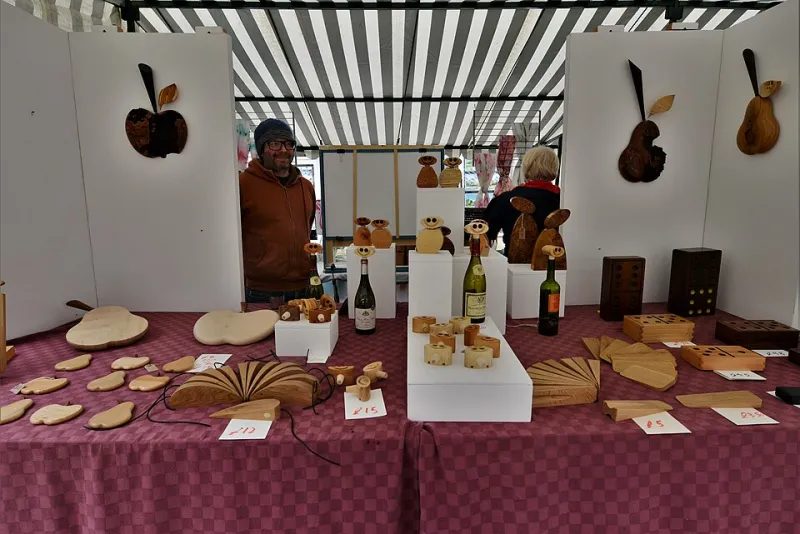
Photo: Michael Garlick , CC BY-SA 2.0, via Wikimedia Commons
By late November 2026, holiday market season is in full swing. The flyer says $150 for a booth, and it sounds like a deal. Six hours, a folding table, a string of lights. What could go wrong?
The booth fee is not the cost of the market. It is the ticket to get in. The real cost is everything that has to happen before, during, and after those six hours—and the break-even number is usually bigger than the first check you write.
Start with the fixed cost, not the vibe
Here is a sample sheet for a small handmade-goods vendor. Your numbers will differ, but the shape is the same.
- Booth fee: $150
- Table cover, sign, and display pieces bought for this market: $35
- Packaging: $40
- Helper pay: $80
- Mileage and parking: $45
- Snacks and coffee: $12
That is $362 before you sell a single item. Payment processing is not fixed, because it moves with sales. Plan on roughly 3% plus 30 cents per transaction if you use a typical card reader. Check your own provider, because the exact rate depends on the plan.
The per-sale number that actually matters
Let us say your average item sells for $28. Your cost of goods is $11. Packaging runs $1.50. Card fees are about $1.14. That leaves $14.36 of profit per sale before the fixed market costs.
Divide $362 by $14.36. You need about 26 sales just to break even. If your average sale is $40 with $16 in goods, $1.80 in packaging, and $1.50 in fees, profit per sale is $20.70. Now you need about 18 sales.
That difference is why 'my stuff is cheaper to make' is not a business plan. The mix matters. So does the price. A market where everyone buys one $12 item is a different animal from a market where three people buy a $95 bundle.
Sales per hour is the reality check
A six-hour market that needs 26 sales needs about 4.3 sales per hour. That is one sale every 14 minutes. Did that market have the traffic to support it? Did your last market? If you were busy but only made 12 sales, you were not busy enough to cover the booth.
This is not a reason to skip every market. It is a reason to stop guessing. Ask the organizer for last year's attendance, vendor count, and average foot traffic. Ask other vendors who have done that show. If the organizer cannot answer basic questions, price that risk into your decision.
Do not forget your time
You may decide not to pay yourself for a first market. That is fine. But track the hours anyway: prep, setup, selling, teardown, and the follow-up emails. If you clear $220 after market costs and spent 16 hours on the whole thing, that is $13.75 an hour before taxes and before the cost of your time making the inventory. It may still be worth it as a customer-acquisition experiment. Just call it what it is.
The follow-up list is the only asset that leaves with you
The market ends. The table gets folded. The leftover inventory goes back in the car. The one thing that can keep paying you is a list of people who said they liked your work.
Put a QR code on the table that goes to a simple signup form. Offer a small reason to join: first look at new items, a market-only discount for a future order, or a monthly email with restock dates. Ask for first name and email. Keep it simple and tell people what they will get.
If 25 people join and four buy again later at $28, that is $112 in future revenue. It does not rescue a bad market by itself, but it changes the math. A market with a follow-up plan is a channel. A market without one is a six-hour pop-up.
The $150 decision
Pay the booth fee when you can see a realistic path to break-even, when the traffic matches your price point, and when you have a way to stay in touch afterward. Skip it when your plan is hope, a Venmo sign, and a friend saying 'you'll sell out.'
Before you pay, check the local rules. Some states and cities require a sales tax permit or a transient vendor license. Some venues require liability insurance. That is not glamorous, but neither is a surprise letter in January.
Run the sheet. If the math works, go. If it does not, save the $150 and find a market where it does.